
Clare Tone

Baling Twine—what barn doesn’t have some!

By Linda P Recently, looking at a handful of baling twine, it made me recall a post I did quite a while ago, What do you do with all that baling twine?  I thought I would revisit this and share some recycling resources. Baling twine just seems to accumulate, with most of it winding up in the landfill. You can’t burn it, the polypropylene twine emits toxic fumes. Worse, is how it can impact wildlife. When wildlife and livestock ingest baling twine they can become seriously ill or die. Twine also poses a deadly strangling hazard to birds. According to Waste-Not Recycling, researchers have reported that baling twine is responsible for entangling and killing around 10 percent of osprey chicks annually in some states (photo right: © Idaho Department of Fish and Game). I reached out to Kennedy Roddy, Education and Outreach Specialist, Boulder County Resource Conservation Division. I was told that this material is NOT recyclable in curbside collections, and was directed to Waste-Not Recycling in Johnstown. I found they offered a great recycling program, list of collection sites by county, and  information about setting up a program at your barn.  They also offer “Bedder“, an animal bedding, that is dust and spore free. It is excellent for at home, stall or shows; and is 100% recyclable, rapidly composts and an excellent worm breeding environment. Please visit them online to find out more. In addition JAX offers baling twine recycling drop-off at their locations in Fort Collins, Loveland, Lafayette, and Broomfield. What Can you Do? Think about starting a collection area at your barn. We […]

Baling Twine—what barn doesn’t have some! Read More »
BCHA Gallops Towards Its 50th Birthday

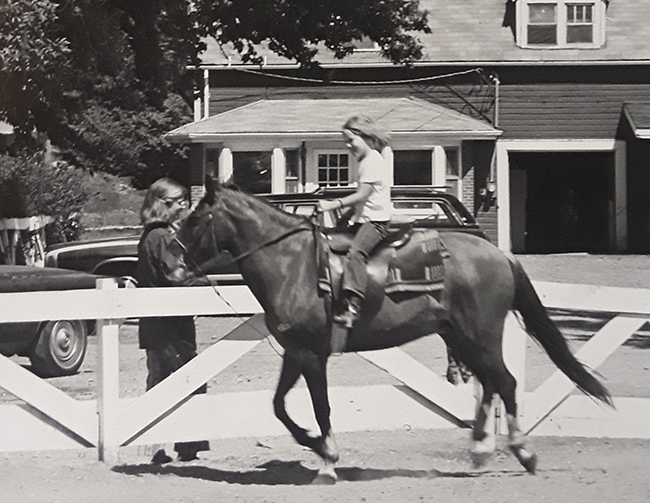
By Clare Tone Feature photo: the author riding Clooney, circa 1974 The year was 1971 and a five-year-old girl was growing up in love with horses in the suburbs of Chicago. She hadn’t yet started weekly horseback riding lessons with her sister, those would start next year. She was shy and butterflies darted in her stomach every time she thought about horses, which was almost every minute of every day. Across the country that same year, in a beautiful hamlet on the brink of a tumultuous transition from rural to cosmopolitan, 110 residents of Boulder County gathered on February 7th at the National Bureau of Standards to form the Boulder County Horsemen’s Association (BCHA). Perhaps it was no fluke that BCHA came into being in what is known today as The National Institute of Standards and Technology, or NIST on South Broadway in Boulder. This is the place that houses the clock by which all clocks in the country are set. A clock that has ticked just shy of 1,576,800,000 times to mark the near fifty years BCHA has done its important work of promoting, protecting and unifying the equestrian community of Boulder County through education, recreation and legislation. Fast forward to 2020 and that little girl is now 53. She can’t help but imagine back to February 7th, 1971 wistfully, picturing 110 people gathered at NIST dressed in flowing flower-patterned shirts and high-waisted bell bottom jeans nearly obscuring dusty cowboy boots. Although her imagination has always run a little wild she knows one thing for sure: If it weren’t

BCHA Gallops Towards Its 50th Birthday Read More »

Giving Back—Colorado Horse Rescue

By Mary Cook Recently retired, I found myself with time on my hands that I wanted to put to good use. I decided to apply to be a volunteer at the Colorado Horse Rescue (CHR) in Longmont, Colorado. Having been a horse lover all my life, and a horse owner for the past 20 years, this seemed like a natural way to give back. After completing orientation, I found myself at work, once a week, as a barn volunteer. What does volunteering at CHR mean? Well, CHR has on average 55 to 60 horses ranging from babies to geriatrics, or “geris” as we fondly call them. These horses come from every walk of life, and as CHR might say, “the only difference between a rescue horse and any other horse is a set of circumstances.” From owners who are sick, to owners who can no longer financially afford to keep a horse, to owners who have older horses with health problems who can’t bear the thought of having to put them down, there are a myriad of reasons why horses end up at rescues. There are also many horses that are rescued from local livestock auctions, where the majority, who are not rescued, are transported to slaughter in Mexico or Canada—a fate not deserving of these animals. As you might expect, there is plenty of mucking, feeding of special diets, haying, watering, and loving. It’s a rather physical job having to lift 50 pounds bags of feed, hay bales and manure buckets, but I found myself connecting with my fellow volunteers

Giving Back—Colorado Horse Rescue Read More »